

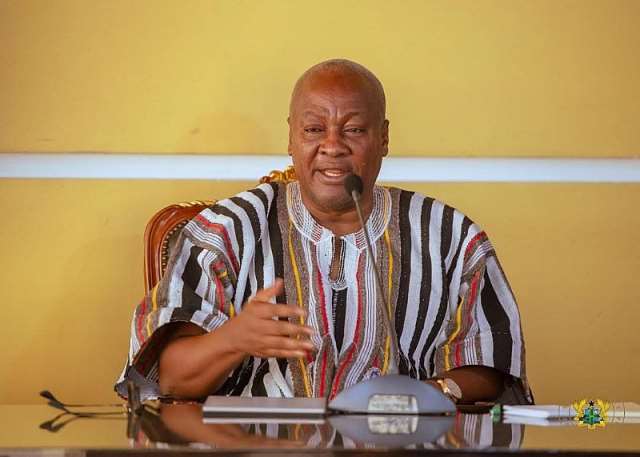
President John Dramani Mahama has fired a warning shot at landlords flouting rental laws, encouraging tenants to abandon their reluctance and officially report demands for advance payments that exceed the mandated six-month limit.
During a high-level meeting with Organised Labour at the Jubilee House on Tuesday, March 17, the President zeroed in on the “major problem” of housing, describing how exorbitant rental costs are systematically draining household incomes and reducing the quality of life for Ghanaian workers.
Mahama argued that the solution lies in a two-pronged approach: a long-term strategy involving a national dialogue to create a sustainable social housing policy, and immediate enforcement of existing laws to protect tenants from predatory practices.
“Housing is a major problem, and for households, it is consuming their income,” Mahama told the labour leaders. He outlined a vision for a collaborative framework where the government, private sector, and labour unions would unite to develop a policy that provides affordable housing for workers, either through mortgages or reasonably priced rentals.
However, the President’s strongest remarks were reserved for the current state of the rental market. He identified the nation’s massive housing deficit as the root cause of the imbalance, giving landlords disproportionate power to bypass the law.
Although legislation clearly restricts rent advances to six months, the reality on the ground often sees tenants forced to pay one or two years upfront.
Mahama pinpointed a critical failure in the system: a mutual reluctance from both tenant and landlord to engage with the Rent Control Department. This “conspiracy of silence,” he suggested, has allowed illegal charges to become the norm.
“The reason why the private house owners are taking advantage is because of the deficit in housing. We have the rent court, and we say do not take more than six months of rent advance, but the one who is renting and the house owner are both not prepared to go to the rent court,” he explained.
By urging tenants to break this silence, Mahama is shifting the responsibility for enforcement from the authorities alone to the citizens themselves.
He assured the public that the government backs them, promising that any landlord brought before the rent court for violating the law would face consequences.
“You can report them to the rent court, and we will ensure they are dealt with,” he stated firmly.
The President’s comments signal a clear intent to leverage legal channels to curb a practice that has long been a source of public frustration and financial hardship.
